Getting started
- Join the Discord and link
In order to access the server, linking to our Discord is required. This integrates additional systems and creates a known bridge between all players and the server.
Note: The /link command can be typed into any channel. It takes about 10 to 30 seconds to reach the server.
- Create a character
- Choose your name, date of birth and a character type. Character names must be
in First + Last format.
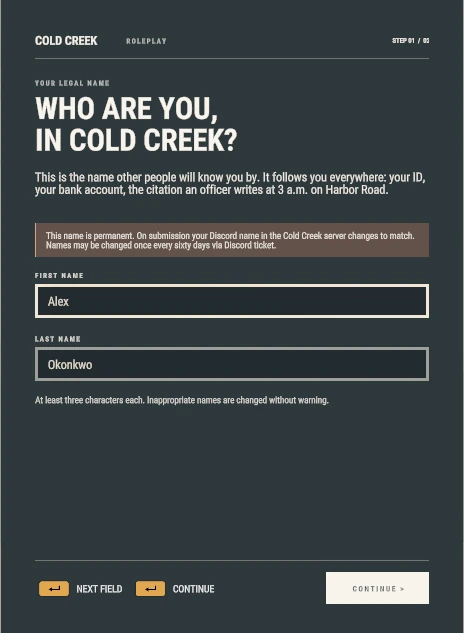
Step 1: Your name 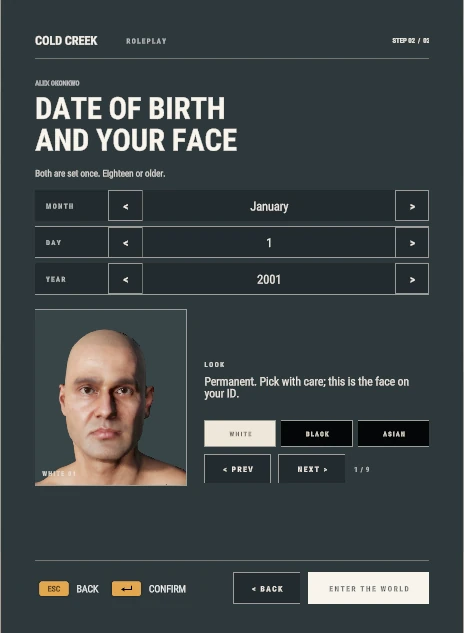
Step 2: Date of birth and face Note: Character names and appearance can only be chosen every 60 days. Pick wisely.
- Your ID
- Your state ID is created with your character, and it is what the CAD looks you up by. Your driver's license is a physical card you carry, with your housing address on it. You can hand your ID to somebody, and an officer can take it from a restrained person.
- CreekLink
- CreekLink is a web-based hub for your character. You are able to view your assets, court docket and statistics through here. For government employees, this is also how they access their systems.
Cash and accounts
- Cash
- Cash is a physical item that is carried on your person in the pocket slot. You are always able to carry cash, even if your inventory is full. Cash stacks, and does not have a limit.
- Accounts
Accounts are separated into two buckets: Checking and Savings.
Checking is money that is available, and can be withdrawn by stores, fines and other transfers.
Savings is not able to be withdrawn by purchases or transfers, but accrues interest weekly.
Transfers may be conducted in person via an ATM or at any G&T bank.
- ATMs and bank tellers
- ATMs are placed around town and cover balance, deposits, withdrawals, transfers and account history. A teller at any G&T bank does the same with no caps on deposits or withdrawals, and runs the loan desk.
- Loans
- Taken at the teller, repaid from checking.
- Getting paid
- An income tick pays you automatically while you are on duty. Vendors can be set to take cash, take the account, or accept either.
Your phone
- Overview
The phone is a physical item that is carried in the pocket slot. Your phone can always be carried, even if your inventory is full. If you lose your phone, or have it taken from you, you may purchase a replacement at any store. Logging back into the server after about 30 minutes away will also regenerate your phone.
The phone itself is not access to you. If someone else takes your phone, they cannot access it.
Opening your phone is done with a keybind, found under Cold Creek > General in the keybind menu.

 Contacts and messaging
Many actions require adding a contact. This can be done through the Contacts app.
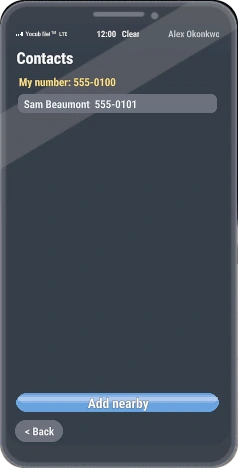
The Contacts app Contacts may be messaged, and have additional options such as sharing keys.
 Map
Map- Simple stuff: your map is accessed via your phone. A physical map item is not required.
 SOS
SOS- Calling 911. Contact the police, EMS or both for assistance at your location. This will transmit your name, your general location and your message (optional).
 Keys
KeysThrough the Keys app, you may share, remove access, and check the status of your various locked property.
Note: To share with people, they must be a contact.
 Chirper
- An in-character message board.
 Market
- List items, properties and vehicles for sale to the server.
 Support
- Support can be contacted through your phone. This will generate a ticket in the Discord, as well as notify staff members.
- Sending money
- Typed amounts, sent from the phone to another person.
Work
- Government jobs
- Government jobs are full-time roleplay positions. These include Police, Fire Rescue, Judicial Staff and Politicians. They are separated from normal jobs in that they have application processes and serve a major function within Cold Creek. If you are interested in any of these, check out the #applications channel in Discord.
- Gathering
- Gathering jobs are simple. Go to a place, collect items or goods either through a wait period or a minigame, and sell them for money. Gathering jobs can be found on the map.
- Deliveries
- Deliveries are both NPC-world and player driven. The premise is simple: take goods from Point A to Point B. These vary from simple courier jobs, where you make the trip on your own, to freight deliveries that require pulling a trailer. They can be found on the map, or through the phone's job portal.
- Tasks
- Tasks are the closest thing to what most people think of as a job. Examples include Garbageman and Forklift Worker. Task jobs can be found on the map.
Crafting
- Coming soon
- This section is still being written.
Vehicles
- Buying one
- At the motors lot. The ownership record is written and the plate is minted before the car ever spawns, so there is no such thing as an unplated purchase.
- The garage
- Store a vehicle and bring it back out. What is in the boot persists with it.
- Locking
- Vehicles are born locked to their owner, and the lock covers every seat including turrets. Vehicle theft is currently switched off at the framework level.
- Registration and the DMV
- The plate is automatic; the registration is not. Register at the DMV terminal, and keep it current. Registrations expire and can be suspended, and police treat the CAD record as the truth.
- Plates
- One format, issued in sequence. There is no temporary tag and no way to choose your own.
- Towing
- A flatbed trailer and a heavy tow truck. An unregistered car is towed rather than argued about.
Property
- Buying property
- Through the realty office. Ownership is a record, the same as a vehicle.
- Door locks
- The lock policy is separate from ownership, so access can be granted without handing over the deed. A gated door replaces the ordinary prompt rather than adding a second one, so there is nothing to walk around.
- Your address
- Your housing address appears on your driver licence and in the CAD lookup.
- Transfers
- Property changes hands from the phone.
Shops and items
- Vendors
- Counters, pads and signs for motors, realty, the store, the gun shop, the armoury, the fleet yard, EMS, the mod shop and the garage. Each vendor is set to take cash, the account, or either.
- Clothing
- Four civilian stores. The pack runs to 68 tops, 48 trousers, 11 pairs of shoes and 6 hats.
- Firearms and serials
- A gun sold over a legal counter is stamped with a serial at the point of sale. A gun with no serial was never sold legally, and that absence is what makes it an illegal firearm in the eyes of the law.
- Safes
- Container storage that persists. Safes are not raidable.
- Pockets
- A pocket slot that carries your ID and your phone, separately from your main inventory.
- Deployables
- Cones, barricades and spike strips, placed from the boot of a police vehicle.
Police and the law
- The CAD
- Computer-aided dispatch. Calls, units, vehicle registrations and character records, on laptops and station screens.
- Citations
- Written against your record and payable. An overdue citation prompts the department to seek a warrant.
- Warrants
- Sought through the CAD and visible to officers. Knowing about one is the first legitimate reason to run, under the evading rules.
- Arrest and handcuffs
- Handcuffs are an item. A restrained person cannot use their inventory, cannot get in or out of a vehicle under their own power, and has their hands locked. Officers escort and load them.
- Search and seizure
- An officer can search a restrained person and take what they find. Article VII of the Bill of Rights says they have to be able to say why.
- Radar
- Dash radar with a live readout and a speed in miles per hour.
- Less lethal
- The Creek Arc stun device, with probes, wires and a laser, and tear gas canisters that blur vision, cause coughing and drain stamina.
Judicial system
- The two-stage system
Cold Creek's justice system runs in two stages.
Stage one is the arrest or citation itself. The arresting officer sets the fine, the jail time or both, following the Book of Laws. These penalties are kept small on purpose: they stand in for the part of a real arrest that comes before arraignment. Once the sentence is served, you go about your life with no restrictions and no label beyond what your arrest report says.
Stage two applies to felonies only. The District Attorney may prosecute a felony further to seek a conviction. You must be notified in writing, through cDocket, within five days of the arrest. After five days, the case is sealed.
Within those same five days, you may contest the arrest and submit evidence through cDocket.
- Criminal case proceedings
Once the District Attorney decides to prosecute, the case ends in a plea deal or a trial.
Plea deal. A plea deal settles the case on the spot, usually with a lighter sentence or a seizure. The District Attorney and the defendant must both agree to it. If they cannot agree, the case goes to trial.
Trial. When a case goes to trial, a trial channel opens automatically for the Judge, the District Attorney, the defendant and three jurors. Jurors are picked at random from the residents of Cold Creek. Each side may strike one juror, who is replaced automatically.
Arguments. Each side gets two turns, and the District Attorney goes first. A side has 24 hours to enter its argument, and the turn passes to the other side as soon as it does.
Verdict. After both sides have had their two turns, the jury deliberates and votes. If it cannot reach a verdict, it deliberates once more. If it still cannot, the trial ends in a mistrial: the case closes and the charges are dropped.
- Sentencing and felon status
Sentencing. After a guilty verdict, the Judge delivers the sentence within 48 hours of the verdict being read. The Judge may set fines of up to five times the amount in the Book of Laws.
Seizure. The most important part of a sentence is the seizure of assets. When a crime involves property or money, the Court may seize vehicles, houses, tools and bank accounts.
Felon status. A felony conviction in court restricts the person convicted. A felon may not possess a firearm, hold a Firearm License, hold a government position or vote.
Staying alive
- Hunger and thirst
- Both tick down. Food and drink are items, and consumables carry modifiers.
- Injury
- A wound lasts until it is treated. EMS respond to calls once a scene is declared safe for entry.
- Death
- Death clears what you were carrying. That is mechanical, not an honour rule, so what you take out with you is a real decision.
- Reconnecting
- Position, health, worn kit and inventory are saved on disconnect and restored when you come back. Disconnecting during a scene is recorded, with who you were fighting and where you had been.
This is a first edition. It covers the systems that have shipped. Anything wrong, missing or out of date is worth a message in Discord, and anything on the road map that is not here yet simply has not been built.
See the road map